PostgreSQL has native support for using SSL connections to encrypt client/server communications for increased security. This requires that OpenSSL is installed on both client and server systems and that support in PostgreSQL is enabled at build time (see Chapter 15).
The first certificate in postgresql.crt must be the client's certificate because it must match the client's private key. 'Intermediate' certificates can be optionally appended to the file — doing so avoids requiring storage of intermediate certificates on the server's root.crt file. For instructions on creating certificates, see Section 18.9.3.
With SSL support compiled in, the PostgreSQL server can be started with SSL enabled by setting the parameter ssl to on in postgresql.conf. The server will listen for both normal and SSL connections on the same TCP port, and will negotiate with any connecting client on whether to use SSL. By default, this is at the client's option; see Section 19.1 about how to set up the server to require use of SSL for some or all connections.
PostgreSQL reads the system-wide OpenSSL configuration file. By default, this file is named openssl.cnf and is located in the directory reported by openssl version -d. This default can be overridden by setting environment variable OPENSSL_CONF to the name of the desired configuration file.
OpenSSL supports a wide range of ciphers and authentication algorithms, of varying strength. While a list of ciphers can be specified in the OpenSSL configuration file, you can specify ciphers specifically for use by the database server by modifying ssl_ciphers in postgresql.conf.
Schlongs of skyrim light version. 2. In next page click regular or free download and wait certain amount of time (usually around 30 seconds) until download button will appead.
Note: It is possible to have authentication without encryption overhead by using NULL-SHA or NULL-MD5 ciphers. However, a man-in-the-middle could read and pass communications between client and server. Also, encryption overhead is minimal compared to the overhead of authentication. For these reasons NULL ciphers are not recommended.
To start in SSL mode, the files server.crt and server.key must exist in the server's data directory. These files should contain the server certificate and private key, respectively. On Unix systems, the permissions on server.key must disallow any access to world or group; achieve this by the command chmod 0600 server.key. If the private key is protected with a passphrase, the server will prompt for the passphrase and will not start until it has been entered.
In some cases, the server certificate might be signed by an 'intermediate' certificate authority, rather than one that is directly trusted by clients. To use such a certificate, append the certificate of the signing authority to the server.crt file, then its parent authority's certificate, and so on up to a 'root' authority that is trusted by the clients. The root certificate should be included in every case where server.crtSharp mx-4070n driver. contains more than one certificate.
17.9.1. Using Client Certificates
To require the client to supply a trusted certificate, place certificates of the certificate authorities (CAs) you trust in the file root.crt in the data directory, and set the clientcert parameter to 1 on the appropriate hostssl line(s) in pg_hba.conf. A certificate will then be requested from the client during SSL connection startup. (See Section 31.17 for a description of how to set up certificates on the client.) The server will verify that the client's certificate is signed by one of the trusted certificate authorities. Certificate Revocation List (CRL) entries are also checked if the file root.crl exists. (See http://h71000.www7.hp.com/doc/83final/ba554_90007/ch04s02.html for diagrams showing SSL certificate usage.)
The clientcert option in pg_hba.conf is available for all authentication methods, but only for rows specified as hostssl. When clientcert is not specified or is set to 0, the server will still verify presented client certificates against root.crt if that file exists — but it will not insist that a client certificate be presented.
Note that root.crt lists the top-level CAs that are considered trusted for signing client certificates. In principle it need not list the CA that signed the server's certificate, though in most cases that CA would also be trusted for client certificates.
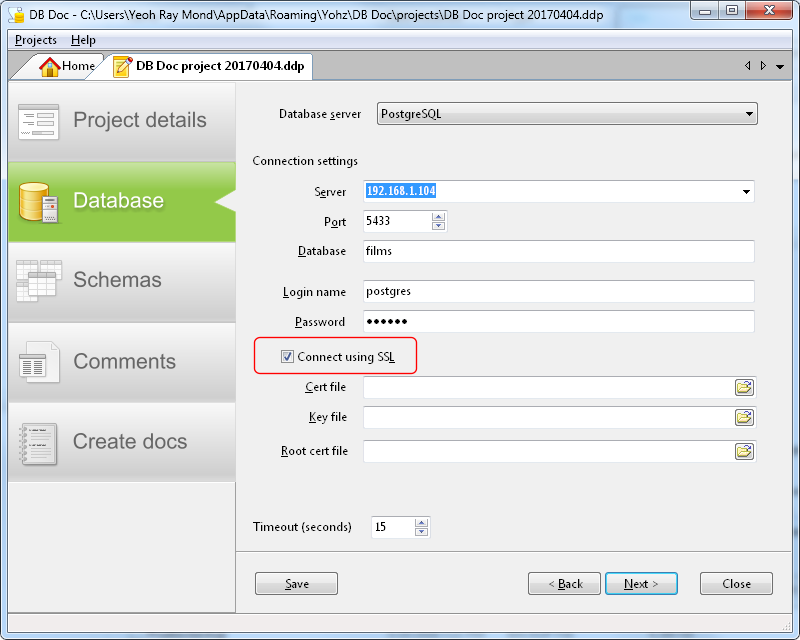
If you are setting up client certificates, you may wish to use the cert authentication method, so that the certificates control user authentication as well as providing connection security. See Section 19.3.10 for details.
17.9.2. SSL Server File Usage
Table 17-3 summarizes the files that are relevant to the SSL setup on the server.
Table 17-3. SSL Server File Usage
| File | Contents | Effect |
|---|---|---|
| $PGDATA/server.crt | server certificate | sent to client to indicate server's identity |
| $PGDATA/server.key | server private key | proves server certificate was sent by the owner; does not indicate certificate owner is trustworthy |
| $PGDATA/root.crt | trusted certificate authorities | checks that client certificate is signed by a trusted certificate authority |
| $PGDATA/root.crl | certificates revoked by certificate authorities | client certificate must not be on this list |
The files server.key, server.crt, root.crt, and root.crl are only examined during server start; so you must restart the server for changes in them to take effect.
17.9.3. Creating a Self-signed Certificate
To create a quick self-signed certificate for the server, use the following OpenSSL command:
Fill out the information that openssl asks for. Make sure you enter the local host name as 'Common Name'; the challenge password can be left blank. The program will generate a key that is passphrase protected; it will not accept a passphrase that is less than four characters long. To remove the passphrase (as you must if you want automatic start-up of the server), run the commands:
Enter the old passphrase to unlock the existing key. Now do:
to turn the certificate into a self-signed certificate and to copy the key and certificate to where the server will look for them. Finally do:
because the server will reject the file if its permissions are more liberal than this. For more details on how to create your server private key and certificate, refer to the OpenSSL documentation.
A self-signed certificate can be used for testing, but a certificate signed by a certificate authority (CA) (either one of the global CAs or a local one) should be used in production so that clients can verify the server's identity. If all the clients are local to the organization, using a local CA is recommended.
-->Azure Database for PostgreSQL prefers connecting your client applications to the PostgreSQL service using Transport Layer Security (TLS), previously known as Secure Sockets Layer (SSL). Enforcing TLS connections between your database server and your client applications helps protect against 'man-in-the-middle' attacks by encrypting the data stream between the server and your application.
By default, the PostgreSQL database service is configured to require TLS connection. You can choose to disable requiring TLS if your client application does not support TLS connectivity.
Enforcing TLS connections
For all Azure Database for PostgreSQL servers provisioned through the Azure portal and CLI, enforcement of TLS connections is enabled by default.
Likewise, connection strings that are pre-defined in the 'Connection Strings' settings under your server in the Azure portal include the required parameters for common languages to connect to your database server using TLS. The TLS parameter varies based on the connector, for example 'ssl=true' or 'sslmode=require' or 'sslmode=required' and other variations.
Configure Enforcement of TLS
You can optionally disable enforcing TLS connectivity. Microsoft Azure recommends to always enable Enforce SSL connection setting for enhanced security.
Using the Azure portal
Visit your Azure Database for PostgreSQL server and click Connection security. Use the toggle button to enable or disable the Enforce SSL connection setting. Then, click Save.
You can confirm the setting by viewing the Overview page to see the SSL enforce status indicator.
Using Azure CLI
You can enable or disable the ssl-enforcement parameter using Enabled or Disabled values respectively in Azure CLI.
Ensure your application or framework supports TLS connections
Some application frameworks that use PostgreSQL for their database services do not enable TLS by default during installation. If your PostgreSQL server enforces TLS connections but the application is not configured for TLS, the application may fail to connect to your database server. Consult your application's documentation to learn how to enable TLS connections.
Applications that require certificate verification for TLS connectivity
In some cases, applications require a local certificate file generated from a trusted Certificate Authority (CA) certificate file (.cer) to connect securely. The certificate to connect to an Azure Database for PostgreSQL server is located at https://www.digicert.com/CACerts/BaltimoreCyberTrustRoot.crt.pem. Download the certificate file and save it to your preferred location.
Connect using psql
The following example shows how to connect to your PostgreSQL server using the psql command-line utility. Use the sslmode=verify-full connection string setting to enforce TLS/SSL certificate verification. Pass the local certificate file path to the sslrootcert parameter.
The following command is an example of the psql connection string:
Tip
Confirm that the value passed to sslrootcert matches the file path for the certificate you saved.
Next steps
Review various application connectivity options in Connection libraries for Azure Database for PostgreSQL.